
Chimney Crown Repair Cost in Greeneville, TN: What You’ll Actually Pay in 2024
Chimney crown repair in Greeneville typically runs $280–$550 for resurfacing or patching and $900–$1,800 for full crown replacement, with most jobs falling in the $350–$650 range for standard resurfacing on an average-sized masonry chimney. Because Greeneville’s freeze-thaw cycle hits harder than Knoxville’s due to the Unaka Mountain ridgelines pushing colder, wetter air into the Nolichucky River valley, crown damage here progresses faster than homeowners expect. Call (888) 799-1933 for a free inspection and exact quote—Matthew Gonzalez, our owner and lead technician, handles every assessment personally.
Why Greeneville’s Climate Destroys Chimney Crowns Faster Than Most Homeowners Realize
You can’t see your chimney crown from the yard. Most homeowners in Greeneville have never looked at theirs. After a few winters of moisture entering those hairline cracks, freezing, expanding, and re-entering—what started as a $300 crown repair is on its way to becoming a $2,000+ rebuild conversation. Matthew sees this progression on in-town Greeneville Victorians every season.
The crown sits at the very top of your chimney, a horizontal mortar surface sloped to shed water. It’s the most exposed piece of masonry on your entire house. In Greeneville, where winter temperatures regularly swing above and below freezing from October through April, water penetrates micro-cracks in the crown, expands when it freezes, and widens those cracks exponentially—not linearly. A crown that looks “fine” in September can show visible spalling by March.
The Unaka Mountains east of town top 4,000 feet and act as a moisture trap, pushing colder, wetter conditions into the Nolichucky River valley than Knoxville experiences. That extra freeze-thaw frequency means Greeneville chimneys endure more annual expansion-contraction cycles than flatter, newer-stock Tennessee cities nearby. We’ve measured the difference on jobs: crowns here deteriorate roughly 30–40% faster than comparable chimneys in the Tennessee Valley proper.
Here’s what that accelerated damage looks like when Matthew’s up on the roof:
- Hairline cracking (early stage): Visible only from the roof, these thin fractures haven’t yet allowed significant water intrusion. Resurfacing with a flexible crown sealant like CrownCoat or equivalent professional-grade material stops progression. Cost: $280–$450.
- Spider-web or map cracking (moderate stage): Networks of interconnected cracks with minor surface spalling—small flakes of mortar coming loose. Requires more extensive prep and possibly a bonding agent before resurfacing. Cost: $400–$650.
- Chunk loss or exposed brick (advanced stage): Pieces of the crown have broken away, revealing the chimney structure beneath. Water has been entering for multiple seasons. Partial rebuild or full replacement necessary. Cost: $900–$1,800+.
- Crown separation from flue liner (critical stage): The crown has pulled away from the flue tiles, creating a gap that dumps water directly into the chimney structure. Often accompanied by interior flue damage. Requires full replacement plus potential liner work. Cost: $1,500–$3,000+.
That escalation from $350 to $2,000+ isn’t hypothetical—it’s the exact progression Matthew documents on inspection reports across Greeneville’s older housing stock, from the Victorian-era homes near Andrew Johnson National Historic Site to the 1920s–1960s farmhouses scattered through rural Greene County.
Crown Repair vs. Crown Replacement: Two Very Different Jobs with Very Different Prices
Generic pages conflate these, which wastes your time and sets wrong expectations. Here’s the honest distinction:
| Service | What It Actually Involves | Typical Cost in Greeneville | When It’s the Right Choice |
|---|---|---|---|
| Crown Resurfacing / Patching | Cleaning existing crown, filling cracks with flexible sealant or trowel-grade repair compound, applying protective slurry coat | $280–$550 | Hairline to moderate cracking; crown still structurally sound; no major spalling or separation |
| Crown Rebuild (Partial) | Removing deteriorated sections, forming and pouring new mortar crown, integrating with sound existing material | $650–$1,100 | Significant chunk loss in limited areas; flue liner still properly seated; chimney structure sound beneath |
| Full Crown Replacement | Complete removal of existing crown; inspection of underlying brick and liner; forming and pouring new reinforced crown with proper overhang, slope, and drip edge | $900–$1,800 | Advanced deterioration; separation from flue; compromised structural integrity; previous repairs failed |
| Crown + Flashing + Liner (Combined) | Full crown replacement plus addressing roofline flashing and any flue damage discovered during teardown | $1,800–$3,500 | Crown failure has masked or caused secondary damage; common on unlined 1930s–1960s farm chimneys in Greene County |
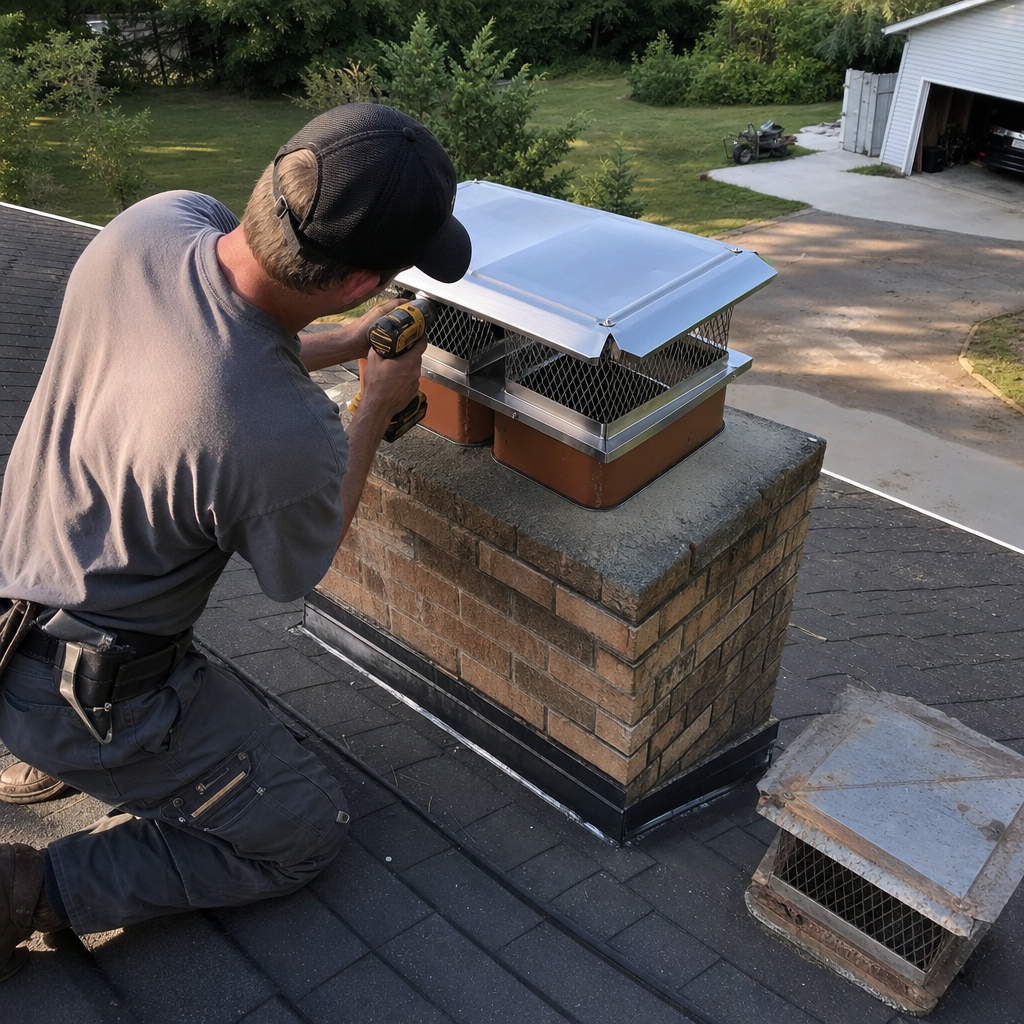
We use CrownCoat and equivalent professional-grade materials from Copperfield and Olympia Chimney for resurfacing work—products that flex with thermal expansion rather than cracking again the first winter. For full replacements, we form and pour proper reinforced crowns with the correct 2-inch minimum overhang beyond the chimney face and a slope of at least 3/8-inch per foot. Handymen and generalists skip these details; we’ve torn off enough of their “repairs” to know the difference.
Matthew’s blunt about this: “I’d rather tell you something you don’t want to hear now than have you call me after a chimney fire.” If your crown needs replacement, not resurfacing, he’ll show you exactly why—photos, probe testing, the actual condition of what’s underneath. No vague scare tactics, just the same detailed reporting that’s earned 387 customers rating us 4.9 stars.
What a Bad Crown Looks Like From the Ground (And What Matthew Finds Up Close)
Since most homeowners never roof-walk their own chimney, here are the field findings Matthew encounters on multi-decade-old Greeneville homes—signs you can spot from below or during a routine sweep:
- White efflorescence streaking down the chimney face below the crown: Water is moving through the crown and dissolving salts in the mortar. By the time this is visible, cracking is established.
- Missing or displaced chimney cap: The cap protects the crown from direct precipitation. Its absence accelerates crown deterioration dramatically.
- Discolored or stained brick directly below the crown: Indicates water is pooling on a flat or improperly sloped crown rather than shedding.
- Vegetation growth in mortar joints: Seeds need moisture to germinate; green growth means water is consistently present.
- Interior water staining on the firebox ceiling or adjacent walls: Crown failure is the most common cause of chimney-related interior water damage, not flashing (though flashing often fails simultaneously).
On rural Greene County calls—those 1930s–1950s tobacco-farm homesteads with original unlined single-flue brick chimneys—Matthew routinely finds crowns that have been deteriorating for a decade or more. These chimneys were often pressed into double or triple duty when wood stoves or inserts were retrofitted decades later, and the crown was never designed for the increased thermal cycling. The shared-flue configurations common in these farmhouses (fireplace, wood stove, and sometimes furnace exhaust all venting through the same flue) create temperature swings that accelerate crown stress.
In-town, the late-Victorian and early-20th-century homes near downtown Greeneville present a different pattern: multi-flue masonry chimneys with advanced mortar joint deterioration from decades of freeze-thaw cycling. Their crowns often show the most damage at the flue penetrations, where differential expansion between the flue tiles and surrounding mortar creates stress fractures.
The Hidden Problem Crown Repair Often Reveals: Compromised Flashing
Here’s something the generic cost pages won’t tell you: crown repair on older Greeneville brick chimneys frequently exposes compromised flashing at the roofline. Water that appears to be crown-related is sometimes, or additionally, entering through deteriorated step flashing, counterflashing, or the reglet seal where the chimney meets the roof deck.
Matthew addresses this in the same visit when it’s found. There’s no point in resurfacing or replacing a crown if water continues entering from below and undermining the repair from the inside. On a typical Greeneville job, he’ll inspect the flashing relationship during the crown assessment—something that requires removing a small section of surrounding roofing material to verify the reglet condition.
This combined approach—crown plus flashing verification—is standard for us because Premier Chimney Cleaning Service handles the full spectrum of chimney work, from your first sweep to a full liner rebuild. We’re not a handyman service that sweeps chimneys as a side gig; Matthew’s 11 years of chimney-only focus means he recognizes the interconnected failure patterns that generalists miss. When we quote crown work, the price includes honest disclosure of whether flashing needs attention too.
Why Greeneville’s Housing Stock Makes Crown Work Specialized
The chimney styles and ages across Greeneville’s market vary enormously, and crown repair isn’t one-size-fits-all:
Rural Greene County farmhouses (1920s–1960s): Original single-flue brick chimneys, often unlined, with simple poured mortar crowns that were never properly reinforced. These require careful evaluation of whether the flue itself can support a modern crown, or whether liner installation should precede crown replacement. We’ve used DuraFlex stainless liners and HeatShield cerfractory resurfacing on these jobs when the flue is compromised.
In-town Victorians and early-20th-century homes: Multi-flue chimneys with more complex crown geometry, often with decorative corbelling or stepped profiles. Crown replacement here requires custom forming and attention to historical appearance—Matthew has rebuilt crowns on these chimneys that maintain the original silhouette while meeting modern performance standards.
Mid-century and later construction: Pre-cast concrete crowns or wash caps, which crack predictably along control joints or due to improper installation. These sometimes allow for targeted repair rather than full replacement if caught early.
Across all these types, the common factor is Greeneville’s climate. The heating season running October through April produces heavier creosote loads, but it also means chimneys experience months of continuous thermal stress—hot flue gases below, freezing precipitation above. The crown is the battleground where these temperature differentials meet.
What Goes Into Our Crown Repair Pricing
We don’t quote over the phone without seeing the chimney. The ranges above reflect what Matthew typically encounters, but final pricing depends on:
- Accessibility: Steep roof pitches, multiple stories, or limited ladder access add setup time and safety equipment requirements.
- Crown size and complexity: A single-flue farmhouse crown versus a multi-flue Victorian with decorative elements.
- Underlying condition: Whether the brick beneath the crown is sound or requires tuckpointing before new crown installation.
- Flue liner status: Separated or deteriorated liners must be addressed before or during crown work.
- Flashings and counterflashings: Whether roofline integration needs renewal.
- Material specification: Standard mortar mix versus polymer-modified or fiber-reincrete compounds for severe exposure conditions.
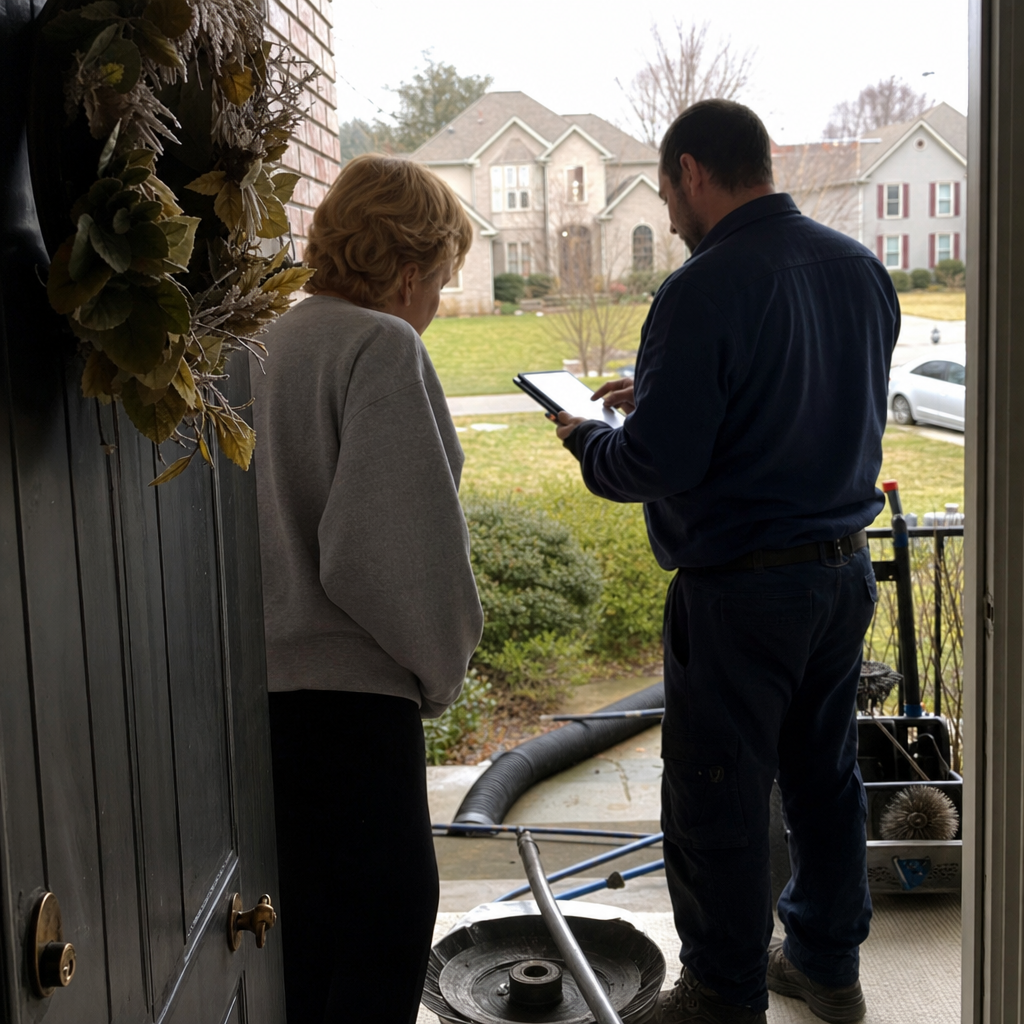
Every quote from Premier Chimney Cleaning Service includes the inspection, detailed photo documentation, and a written scope with no hidden add-ons. Matthew performs every assessment himself—no subcontractor arriving with a clipboard and a guess.
FAQs
Most chimney crown repairs in Greeneville cost between $280 and $650 for resurfacing or patching, while full replacement typically runs $900 to $1,800 depending on chimney size and underlying condition. The exact price requires a roof-level inspection because crown damage that’s invisible from the ground often reveals additional needs like compromised flashing or flue separation. Call (888) 799-1933 for a free estimate—Matthew Gonzalez, our owner and lead technician, handles every assessment personally.
Repair is cheaper if the crown is structurally sound with only surface cracking—resurfacing costs $280–$550 versus $900–$1,800 for full replacement. However, applying resurfacing material to a crown that’s already separating from the flue or shedding chunks is false economy; the repair fails within one to two seasons and you’re paying for replacement anyway. Matthew evaluates this with a probe test and visual inspection of the crown’s bond to the chimney structure before recommending either approach.
Same-day repair is possible for straightforward resurfacing jobs when the crown is accessible and weather permits—the material needs dry conditions and adequate temperature to cure properly. Full crown replacement requires forming, pouring, and cure time, so we typically schedule a return visit within one to three days. Emergency temporary waterproofing is available if active water intrusion threatens interior damage. Call (888) 799-1933 to discuss timing.
Crown damage alone rarely requires full chimney rebuilding unless water has been entering long enough to compromise the structural brick beneath. Key indicators that the problem extends deeper include: significant brick spalling below the crown line, visible mortar erosion through multiple courses, interior water damage to framing or drywall, or a chimney that shows lean or movement. Matthew’s inspection includes sounding the brick with a hammer and visual assessment of the upper courses to distinguish crown-localized damage from systemic deterioration. Most Greeneville homeowners who call early enough need only crown work, not rebuilding.
Ready for an Honest Assessment of Your Chimney Crown?
We’ve resurfaced and rebuilt crowns across Greeneville’s full range of chimney styles and ages—this isn’t a task we estimate cautiously because it’s unfamiliar. Matthew Gonzalez, owner and lead technician at Premier Chimney Cleaning Service, brings 11 years of chimney-only experience and the hands-on accountability of someone whose name is on every job. From routine Chimney Cap & Crown maintenance to full crown replacement integrated with liner and flashing work, we handle it without subcontracting or guesswork.
Call (888) 799-1933 today for your free inspection and written estimate. We’ll show you exactly what your crown looks like, what it needs, and what it costs—no upselling, no vague warnings, just the straight information that earned us 387 verified reviews averaging 4.9 stars.
Written by Matthew Gonzalez, Owner & Lead Technician at Premier Chimney Cleaning Service Greeneville, serving Greeneville, TN.