
Chimney Flashing Repair in Greeneville, TN: What Roofers Miss and Chimney Specialists Fix
Chimney flashing repair in Greeneville typically runs $350–$850 for standard counter-flashing re-embedding and tuckpointing, or $900–$1,800 when step flashing replacement and mortar bed reconstruction are needed. Most jobs finish in a single day. Call (888) 799-1933 for a free inspection and exact quote — Matthew Gonzalez, Owner & Lead Technician, handles every assessment personally.

Greeneville’s position in the Nolichucky River valley, with the Unaka Mountains pushing colder, wetter winters than Knoxville sees, means our chimneys endure more freeze-thaw cycles than most Tennessee homeowners realize. Those cycles don’t just damage brick — they quietly destroy the mortar joints that chimney flashing is designed to anchor into. After eleven years of chimney-only work in this market, we’ve learned that flashing leaks on older Greeneville homes are almost always misdiagnosed as roof problems. A roofer patches the symptom; a chimney specialist fixes the cause.
Why Your Chimney Still Leaks After the Roofer “Fixed” It
If a roofer has caulked your chimney flashing twice in five years and it still leaks, the problem isn’t the flashing material — it’s the mortar joint the flashing is supposed to anchor into. On in-town Greeneville’s late-Victorian brick chimneys, decades of freeze-thaw cycling have eroded those mortar joints to the point where no surface sealant holds long-term. The fix lives inside the masonry, not on top of it.
Here’s what most roofers don’t tell you: chimney flashing is a two-part system, not a single piece of metal.
- Base flashing — the lower metal layer that integrates with your roof’s shingles or membrane. This is what roofers see and typically address.
- Counter-flashing (or step flashing) — the upper metal layer that’s physically embedded into the chimney’s mortar joints, folded down over the base flashing to create a water-tight overlap. This is where the real failure happens on older Greeneville homes.
Roofers are trained to manage water at the roof plane. When they see a chimney leak, their instinct is to seal the base flashing — caulk the edges, maybe replace the metal if it’s corroded. But if the counter-flashing’s reglet (the groove cut into the mortar joint where the metal seats) has crumbled from freeze-thaw damage, no amount of caulk or new base metal solves anything. Water simply finds the next gap in the deteriorated mortar and enters behind the counter-flashing.
We’ve inspected dozens of Greeneville homes where homeowners spent $400–$800 on repeated roofing repairs before calling us. In nearly every case, the counter-flashing reglets were powdery or missing entirely, and the step flashing had pulled away from the chimney face. The roofing work was competent; it just wasn’t the right trade for the actual problem.
What Proper Chimney Flashing Repair Actually Involves
At Premier Chimney Cleaning Service Greeneville, we approach flashing repair as masonry restoration first, metalwork second. Matthew Gonzalez, our Owner & Lead Technician, learned this sequence early — his trade coursework at Walters State Community College in Morristown covered combustion and venting systems, but years of hands-on work on Greeneville roofs taught him that chimney flashing lives at the intersection of two trades, and most practitioners only understand half of it.
Our flashing repair process includes:
- Mortar joint assessment — We probe the counter-flashing reglets to determine if the mortar bed can be re-established or needs full reconstruction. On Victorian-era Greeneville chimneys with advanced spalling, this is where we find the real damage.
- Tuckpointing of reglets — We cut fresh, clean grooves into sound mortar (or rebuild the joint entirely) to create a proper mechanical anchor for counter-flashing. No caulk-dependent “solutions.”
- Correct metal overlap geometry — Counter-flashing must extend far enough down the chimney face to overlap base flashing by a minimum of 2–3 inches, with proper pitch to shed water. We see plenty of installations where this overlap is insufficient or the metal is flat against the brick, creating a capillary channel for water.
- Material-matched replacement when needed — For step flashing that’s corroded or improperly integrated, we source professional-grade materials through our supply network. We work with HeatShield refractory systems for associated crown repairs and Gelco chimney components when cap or shroud replacement is part of the job.
The distinction matters: a roofer sees flashing as a waterproofing detail. We see it as a structural masonry connection that happens to manage water. That difference in framing leads to fundamentally different repairs.
When Step Flashing Needs Replacement vs. Re-embedding
Not every flashing job needs new metal. Here’s how we make that call on Greeneville homes:
| Condition | Repair Approach | Typical Cost Range |
|---|---|---|
| Counter-flashing reglets intact, minor mortar erosion | Re-embed existing metal with fresh mortar, seal overlap | $350–$550 |
| Reglets deteriorated, base flashing sound | Tuckpoint reglets, re-embed counter-flashing | $550–$850 |
| Step flashing corroded or improperly lapped | Replace step flashing, rebuild reglets, integrate with base | $900–$1,400 |
| Multiple flue chimney with extensive mortar loss (common on Victorian multi-flue stacks) | Full mortar bed reconstruction, custom-fabricated counter-flashing | $1,200–$1,800 |
| Associated crown damage or cap failure | Add crown repair or Olympia Chimney cap installation | $200–$600 additional |
We keep a stock of common flashing profiles and work with Famco supply partners for custom copper or stainless configurations when a historic Greeneville chimney requires it. Most competitors don’t maintain this inventory — they’ll order after diagnosis, adding a week to your leak.
Why Greeneville’s Housing Stock Makes This Especially Common
Greeneville’s chimney flashing problems aren’t distributed randomly. They’re concentrated in specific housing types that amplify risk:
In-town Victorian and early-20th-century homes — The late-Victorian brick chimneys in neighborhoods near the original town core were built with multi-flue configurations on steep-pitched rooflines. More flues mean more chimney surface area intersecting with the roof plane. More surface area means more linear feet of flashing, more mortar joints, and more potential failure points. These chimneys also tend to have been repointed multiple times over a century, often with incompatible Portland cement mixes that trap moisture and accelerate the very freeze-thaw damage that destroys reglets.
Rural Greene County tobacco farmhouses — The 1920s–1960s homesteads scattered through the county often feature original unlined single-flue chimneys that were later pressed into service for wood stoves or inserts. When we get called for “chimney leaks” on these properties, the flashing failure is frequently accompanied by other issues: insufficient clearance to combustibles, deteriorated crown wash, or the shared-flue configurations we routinely discover — a fireplace, wood stove, and sometimes furnace exhaust all drawing through a flue never designed for multiple appliances. The flashing repair is straightforward; the overall chimney condition often isn’t.
The Unaka Mountain ridgelines east of town push local winters measurably colder and wetter than Knoxville’s. Our heating season runs October through April, and homeowners here burn Appalachian hardwood — oak and hickory — heavily. That combustion pattern, combined with more annual freeze-thaw cycles than flatter Tennessee cities, creates a wear profile on chimney exteriors that generalist roofers simply don’t encounter often enough to recognize.
The Real Cost of Waiting: A Straight Calculation
Chimney flashing repair is one of the lower-cost jobs we handle. Deferred flashing failure is one of the most expensive.
When counter-flashing separates from a deteriorated mortar joint, water doesn’t just enter at the roofline. It runs down the chimney’s interior face, saturating the masonry from inside — a pattern you can’t see from the ground. Over two or three heating seasons, this saturation causes:
- Rafter tail rot at the chimney penetration
- Ceiling drywall damage and insulation saturation
- Interior masonry spalling (the freeze-thaw cycle continues inside the chimney structure)
- Potential rust-out of fireplace dampers or connector pipes
We’ve opened up chimney breasts in Greeneville homes where the repair history told the story: $200 in caulk, then $400 in more caulk, then $3,000 in interior drywall and framing repair, then finally the $700 flashing rebuild that should have happened first. The math isn’t complicated. Flashing repair at $350–$850, done once correctly, prevents $5,000–$15,000 in downstream damage.
I’d rather tell you something you don’t want to hear now than have you call me after a chimney fire — or after your ceiling collapses from three years of hidden water intrusion.
How to Tell If You Need a Chimney Specialist vs. a Roofer
Some leaks genuinely are roof problems. Here’s the pattern that points to chimney-specific failure:
- Leak appears or worsens during freeze-thaw cycles in late winter, not during heavy rain alone
- Water stains on interior walls track directly to the chimney breast, not general ceiling areas
- Previous “repairs” involved caulk or sealant applied to the chimney face, not mortar work
- Your home was built before 1950 with original masonry chimney
- You can see gaps or separation between metal flashing and brick surface from ground level
If two or more of these match your situation, call us before calling another roofer. We’ll inspect at no charge and tell you honestly whether the problem is in our scope or theirs. We’ve referred homeowners to competent roofers when the issue was genuinely at the roof plane — we’re not interested in fixing what isn’t broken.
Our Chimney Repair in Greeneville page covers our full range of masonry and structural work, from tuckpointing through full rebuilds. Flashing repair often reveals adjacent needs: crown wash deterioration, cap failure, or liner damage that water intrusion has accelerated. As a full-service chimney specialist, we can address these in the same visit rather than coordinating multiple contractors.
What to Expect When Matthew Shows Up
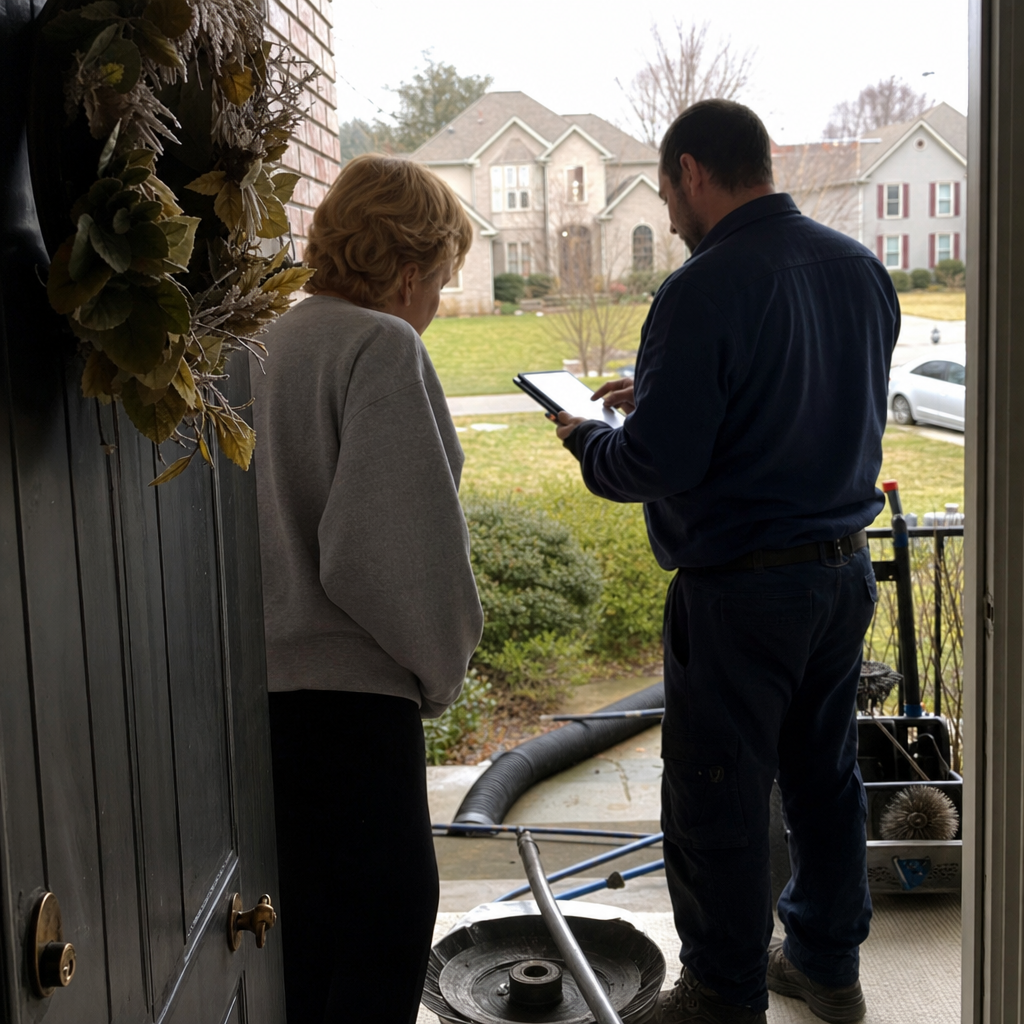
Matthew Gonzalez personally performs every flashing assessment — no subcontractors, no unsupervised apprentices. He’ll photograph the chimney from roof level, probe the mortar joints with a sounding tool, and show you the specific failure points on a tablet before discussing options. His inspection reports tend to be blunt and detailed rather than vague; that’s the feedback we get consistently in our 387 customer reviews averaging 4.9 stars.
Most flashing repairs schedule within 3–5 business days. Emergency tarping is available if active leaking threatens interior damage. We carry professional-grade materials from DuraFlex, HeatShield, Gelco, Olympia Chimney, Famco, and Copperfield — products typically reserved for commercial or specialty contractors — so we’re not waiting on supplier deliveries for standard jobs.
FAQs
Standard chimney flashing repair in Greeneville ranges from $350 to $850 for counter-flashing re-embedding and tuckpointing, while jobs requiring step flashing replacement or extensive mortar reconstruction run $900 to $1,800. The exact price depends on chimney height, roof pitch accessibility, and whether multiple flues create additional flashing surface area. Call (888) 799-1933 for a free, no-obligation inspection and written estimate.
The roofer likely addressed only the base flashing — the metal at the roof plane — while missing the deteriorated mortar joint that anchors the counter-flashing into the chimney itself. Caulk and sealant can’t bond to powdery or missing mortar; water simply finds the next gap. This is especially common on Greeneville’s pre-1950 masonry chimneys where decades of freeze-thaw cycling have eroded the reglet grooves. A chimney specialist rebuilds the mortar anchor point, which is the actual source of the leak.
Chimney flashing repair is dramatically less expensive than roof replacement and addresses a localized failure rather than a whole-system problem. However, if your roof is within 3–5 years of replacement anyway, coordinate the flashing work with the roofing project — but insist the roofer uses a chimney specialist for the counter-flashing reglet work, not just caulk. We’ve re-repaired too many “new roof” flashing jobs where the mortar bed was never touched.
We perform flashing repair year-round in Greeneville, but mortar work requires temperatures above 40°F for proper curing. During colder months, we can install temporary waterproofing to stop active leaks and schedule the permanent repair during the next viable weather window. Waiting until spring risks three more months of water intrusion into your chimney structure and framing — the damage doesn’t pause for convenient scheduling. Call (888) 799-1933 and we’ll assess whether your situation needs immediate action or can wait safely.
Get an Honest Assessment Before Spending Another Dollar on Caulk
Chimney flashing failure doesn’t fix itself, and repeated surface sealing only delays the inevitable while hidden damage accumulates. If you’re in Greeneville or rural Greene County and suspect your chimney leak originates at the roofline intersection, call (888) 799-1933 for a free inspection. Matthew Gonzalez will show you exactly what’s failing, explain whether the repair is in our scope or a roofer’s, and give you upfront pricing with no pressure. From your first sweep to a full liner rebuild, we’re the one company that handles every stage of chimney need — and we don’t caulk over crumbling mortar.
Written by Matthew Gonzalez, Owner & Lead Technician at Premier Chimney Cleaning Service Greeneville, serving Greeneville, TN.