
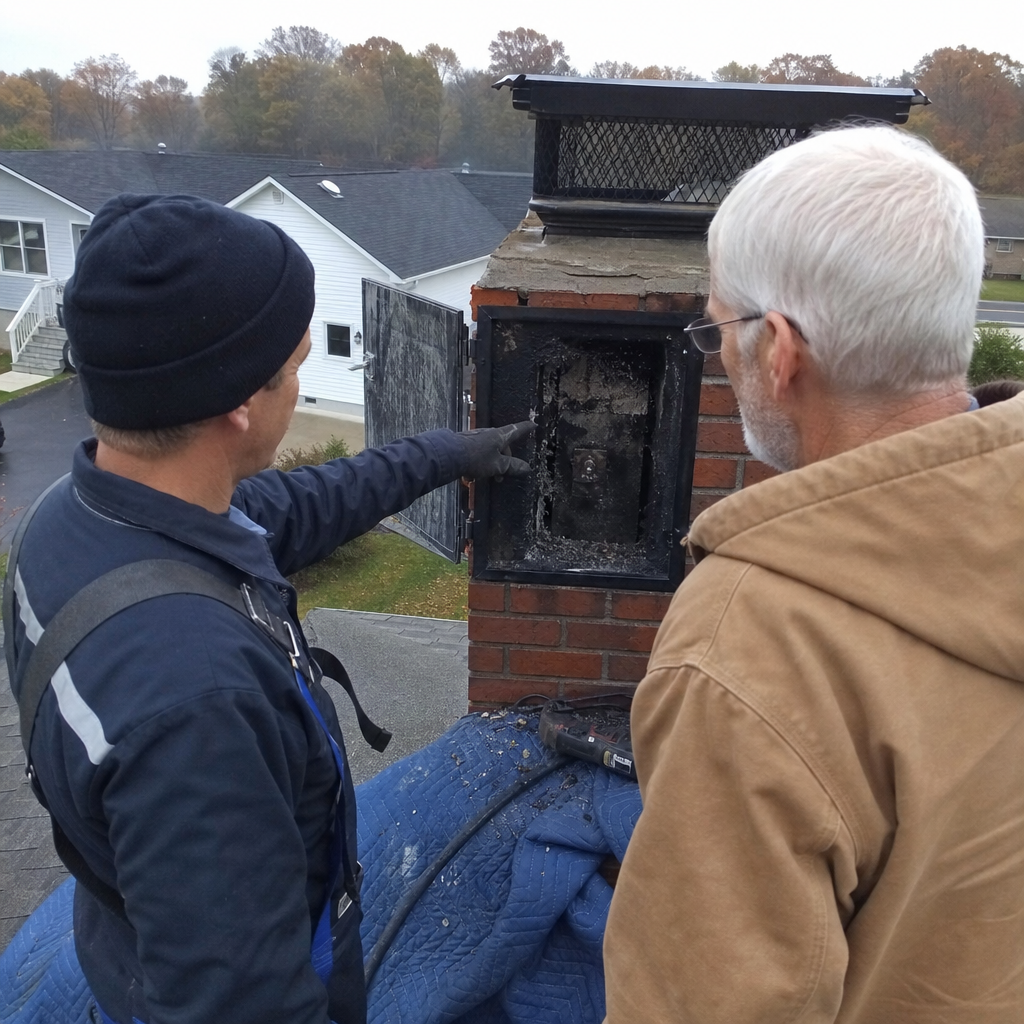
How Often Should You Clean Your Chimney in Greeneville, TN? The Real Answer Starts Before “Once a Year”
Most chimneys in Greeneville need cleaning at least once per year, but heavy-burning households with unlined flues or wood stove inserts should consider a mid-season inspection — especially when you’re putting three or more cords of oak or hickory through a tobacco-era farmhouse chimney that was never designed for that load. Call (888) 799-1933 for a free assessment of your actual burn profile and flue condition.

Last March, Matthew Gonzalez pulled a full five-gallon bucket of Stage 2 creosote from a chimney on a rural Greene County property near the Nolichucky River. The homeowner had followed the standard advice — one cleaning per year, every October, like clockwork. What the schedule didn’t account for was six straight months of evening fires in an unlined 1940s brick flue, burning nothing but seasoned hickory, with no mid-season check. By late February, that creosote had hardened into a glossy, tar-like coating that no brush from a hardware store was touching. The chimney was technically “cleaned annually.” It was also a week away from being genuinely dangerous.
That story is more common than you’d think in Greeneville. The National Fire Protection Association recommends annual inspection and cleaning as a baseline. In this market, that’s where the conversation starts, not where it ends.
Why “Once a Year” Is a Floor, Not a Ceiling, for Greene County
The NFPA 211 standard — inspect annually, clean when buildup exceeds 1/8 inch — was written for average conditions across the entire country. Greeneville doesn’t have average conditions. Three factors push most local households toward the higher end of maintenance frequency:
- Extended heating seasons: With the Unaka Mountain ridgelines backing the Nolichucky River valley, Greeneville runs measurably colder and wetter than Knoxville. The practical heating season stretches October through April — six months, not the four you’d find in flatter Middle Tennessee. More burn days equals more creosote accumulation per calendar year.
- Dense hardwood combustion: Oak and hickory dominate local firewood supplies, and for good reason — they burn hot and long. They also produce a specific creosote profile: slower-forming but denser deposits that advance from Stage 1 (sooty, brushable) to Stage 2 (shiny, tar-like, requiring specialized tools) over a full season of steady use. Softwoods like pine get a bad reputation for “dangerous creosote,” but their deposits are typically lighter and more easily removed. Hardwood creosote is the sneaky kind — it doesn’t look alarming until it’s genuinely hard to remove.
- Unlined and aging flue stock: Rural Greene County’s tobacco-era farmhouses — built from the 1920s through the 1960s — commonly feature original single-flue masonry chimneys constructed without clay tile liners. When a wood stove or insert was retrofit decades later, that rough brick interior became the flue surface. Rough masonry traps creosote far more aggressively than smooth clay tile or stainless steel. A lined flue might reach 1/8 inch buildup in a season. An unlined flue in the same conditions can double that rate.
Matthew Gonzalez, Owner & Lead Technician at Premier Chimney Cleaning Service Greeneville, puts it plainly: “I’d rather tell you something you don’t want to hear now than have you call me after a chimney fire.” In eleven years of chimney-only work across Greeneville and surrounding Greene County, he’s found that the properties needing mid-season attention almost never predict it themselves — they follow the annual schedule and assume that’s sufficient.
The Actual Variables That Determine Your Cleaning Frequency
Forget the calendar for a moment. These four factors determine how fast your flue actually accumulates combustible deposits:
Appliance Type and Burn Efficiency
Open fireplaces run cooler and less efficiently than closed-combustion wood stove inserts. A cooler flue gas temperature means more condensation on flue walls, which means more creosote formation per cord burned. If you’ve retrofitted a wood stove insert into an older Greeneville home’s fireplace — common in the 1970s and 1980s — the insert may run efficiently, but the connecting flue liner (if one was installed at all) may be undersized or improperly configured, creating turbulence that deposits creosote in unexpected locations.
Gas fireplaces and inserts produce minimal creosote but carry their own maintenance requirements — debris, moisture, and deteriorating connections need annual inspection even when “cleaning” isn’t the primary concern.
Fuel Species and Moisture Content
Greeneville’s firewood market runs heavy on red and white oak, hickory, and occasional maple — all excellent BTU sources when properly seasoned. The critical variable is moisture content. Wood burned at 25% moisture versus 15% moisture can produce two to three times the creosote load, because evaporating water cools the flue gases and extends condensation time.
Even well-seasoned hardwood produces that denser Stage 2 creosote profile over a full season. If you’re burning more than three cords per winter in Greeneville, you’re in the category where a single annual sweep may leave significant hardened deposits in place by spring.
Flue Liner Condition and Presence
This is where Greeneville’s housing stock becomes critical. A stainless steel liner — brands like DuraFlex or Olympia Chimney systems that we install for customers needing full relines — presents a smooth surface that sheds deposits and allows more predictable cleaning intervals. Clay tile liners, common in 1960s-and-later construction, are decent when intact but develop gaps and spalling that create creosote traps.
The unlined brick flues common in rural Greene County’s older farmhouses? Every mortar joint, every surface irregularity, every slight offset from decades of freeze-thaw cycling becomes a creosote collection point. These chimneys don’t just need more frequent cleaning — they need more thorough cleaning, with rotary power tools and specialized chains that actually scour the surface rather than skimming over it.
Burn Frequency and Season Length
Greeneville’s six-month heating season isn’t theoretical. When Matthew’s scheduling calls spike in October, it’s not just proactive homeowners — it’s often people who’ve been burning since late September and finally noticed draft problems or smoke smell. The properties that burn five to seven nights per week through that full stretch accumulate creosote on a completely different curve than weekend-only users.
What Matthew Actually Finds on First-Time Greene County Inspections
After eleven years of owner-operated work, the pattern is consistent. First-time customers in rural Greene County — particularly on properties with tobacco-era homesteads — routinely reveal chimneys that haven’t been professionally swept in three to five years. Sometimes longer. The inspection findings on these visits tell a clear story:
- Unlined flues with 1/4 to 1/2 inch of hardened Stage 2 creosote, often with glossy black runs indicating active condensation zones
- Shared-flue configurations where a single 1930s–1950s brick chimney serves multiple appliances — fireplace, wood stove insert, and occasionally a furnace vent — a code violation that’s nearly universal in unmodified farmhouses and almost never reported by the homeowner because “it’s always been that way”
- Mortar joint deterioration advanced by Greeneville’s freeze-thaw cycling, with spalled brick and eroded crowns that let water accelerate the damage
- Improperly installed or missing chimney caps, allowing rain, leaves, and animal nesting directly into the flue
These aren’t edge cases. They’re the dominant service reality in this market. The Chimney Cleaning & Sweep work we perform in Greeneville regularly starts with education — showing the homeowner what their flue actually looks like versus what they assumed — before any brush touches brick.
A Practical Decision Framework for Greeneville Homeowners
Based on burn profile and flue condition, here’s how Matthew Gonzalez structures recommendations for local customers:
| Your Situation | Recommended Minimum | Consider Adding |
|---|---|---|
| Light use: under 3 cords/season, open fireplace, lined flue (stainless or intact clay tile), weekend-primary burning | Annual inspection and cleaning, early fall before first fire | Visual self-check of cap and crown condition in late winter |
| Moderate use: 2–3 cords/season, any appliance type, unknown or mixed liner condition | Annual professional inspection and cleaning; camera inspection every 2–3 years | Mid-season draft and smoke performance check; call if you notice any change |
| Heavy use: 3+ cords/season, wood stove insert, unlined or deteriorated flue, nightly burning October–April | Pre-season cleaning and inspection; mid-season assessment (January–February) | Full camera inspection annually; evaluate liner installation with stainless systems like DuraFlex or HeatShield resurfacing for unlined masonry |
| First professional inspection in 3+ years, rural Greene County tobacco-era property | Immediate Level 2 inspection with internal camera; cleaning as needed based on findings | Structural assessment of crown, mortar joints, and flue integrity; plan for liner installation if unlined and actively used |
The “annual” baseline assumes you’re starting each October with a clean flue. If you’re not — if you’re carrying hardened deposits from previous seasons — you’re not really on an annual cycle. You’re on an “every twelve months we add more” cycle, which is how chimneys become hazardous without homeowners realizing.
Why DIY Cleaning Usually Misses the Real Problem
Hardware store chimney brushes and extension rods have their place — mainly for very light maintenance between professional visits on straightforward, lined flues in good condition. What they don’t do:
- Reach and properly scour the entire flue surface, especially in offset or unlined configurations where deposits concentrate in corners and mortar joints
- Remove Stage 2 or Stage 3 creosote, which requires rotary power tools, specialized chains, or chemical treatment followed by mechanical removal
- Provide any inspection of the flue interior — cracks, spalling, liner gaps, or structural deterioration invisible from the firebox or roof
- Address crown, cap, flashing, or exterior masonry conditions that affect flue performance and water intrusion
Matthew’s found plenty of “DIY cleaned” chimneys where the homeowner ran a brush down from the top, felt resistance stop, and assumed the job was done — when the brush had simply hung up on a ledge of hardened creosote or a liner offset, leaving the majority of the flue untouched. The home page of our site outlines what a full professional service includes, but the short version is: if you haven’t seen your flue interior with a camera, you don’t know its condition.
When “Clean” Isn’t Enough: Liner and Repair Considerations
For Greeneville’s unlined flue stock, cleaning addresses the symptom. The underlying condition — rough brick interior, deteriorated mortar, often improper sizing for modern appliances — persists. After eleven years of seeing the same chimneys return with recurring heavy buildup, Matthew Gonzalez recommends that active-burning households on rural properties evaluate liner installation as a longer-term solution.
Options we install using professional-grade materials include:
- Stainless steel relining: DuraFlex and Olympia Chimney systems for wood, pellet, and gas applications, providing a smooth, correctly-sized flue path that reduces creosote accumulation and meets modern code requirements
- HeatShield cerfractory resurfacing: For clay tile flues with minor deterioration — a specialized resurfacing system that seals gaps and spalling without full liner replacement
- Gelco and Famco caps and accessories: Properly specified chimney caps that prevent water intrusion and animal entry while maintaining adequate draft
These aren’t upsells — they’re solutions to recurring problems that cleaning alone won’t fix. A lined flue cleans easier, performs more predictably, and provides documented safety compliance that matters for insurance and resale.
FAQs
A standard sweep and Level 1 inspection for a lined fireplace flue in Greeneville typically runs $180–$260; unlined flues or those with significant Stage 2 creosote requiring rotary power cleaning generally fall in the $280–$400 range depending on accessibility and buildup severity. Heavy-burning households needing mid-season checks should budget for two service visits annually rather than one deeper clean — it’s safer and ultimately more thorough. Call (888) 799-1933 for an exact quote on your specific flue type and condition — estimates are free.
Even with light use, annual inspection is the recommendation we stand by — creosote isn’t the only concern; moisture intrusion, animal nesting, and structural deterioration from Greeneville’s freeze-thaw cycles can create hazards independent of burn frequency. That said, a properly lined flue with under one cord burned annually, using well-seasoned hardwood, may not require mechanical cleaning every single year — but it does require professional eyes on it to make that determination. We’ve found active bird nests and significant water damage in chimneys that hadn’t been fired in two seasons. Call (888) 799-1933 and we’ll assess whether your light-use profile genuinely allows extended intervals or if you’re risking an undetected problem.
Over a five-to-seven-year horizon, liner installation typically wins on both cost and safety for active-burning households — recurring heavy cleanings of unlined flues add up, and the underlying deterioration continues. For a property burning 3+ cords annually, you’re looking at potentially $200–$350 per cleaning with the aggressive buildup unlined brick produces, versus a one-time liner investment that reduces future maintenance needs and eliminates the code-compliance and insurance-documentation issues common with shared-flue or unlined configurations. Matthew evaluates this tradeoff honestly on inspection — if your flue condition and burn profile don’t justify liner installation, he’ll tell you. Call (888) 799-1933 for a no-pressure assessment.
During Greeneville’s pre-season rush — typically mid-September through mid-November — our schedule fills two to three weeks out, though we maintain limited emergency slots for active hazards like blocked flues or suspected chimney fires. If you’re reading this in late October and haven’t scheduled, call (888) 799-1933 immediately; we’ll either fit you in or get you on the calendar with clear guidance on safe interim burning practices. Waiting until you smell smoke or see visible creosote dripping is waiting too long.
What to Expect from a Premier Chimney Cleaning Service Visit
When Matthew Gonzalez arrives at your Greeneville property, you’re getting the owner — not a subcontractor, not an apprentice working unsupervised. The process is straightforward: exterior assessment of crown, cap, and visible masonry; interior inspection of firebox, damper, and smoke chamber; full flue cleaning with brushes or rotary tools matched to your flue type and condition; and camera inspection of the flue interior when indicated by age, condition, or customer request.
You’ll receive a clear report on what was found, what was done, and what — if anything — needs attention before next season. No vague reassurances, no manufactured urgency. With 387 customers rating our work 4.9 stars, the standard we’ve set is specific, documented, and honest.
If you’re uncertain where your chimney falls on the frequency spectrum — annual sufficient, or mid-season warranted — the fastest path to clarity is a professional look. Premier Chimney Cleaning Service Greeneville offers no-pressure assessments throughout Greeneville and surrounding Greene County. Call (888) 799-1933 to schedule, or to discuss your burn profile and get a straight answer on what your flue actually needs.
Written by Matthew Gonzalez, Owner & Lead Technician at Premier Chimney Cleaning Service Greeneville, serving Greeneville, TN.