
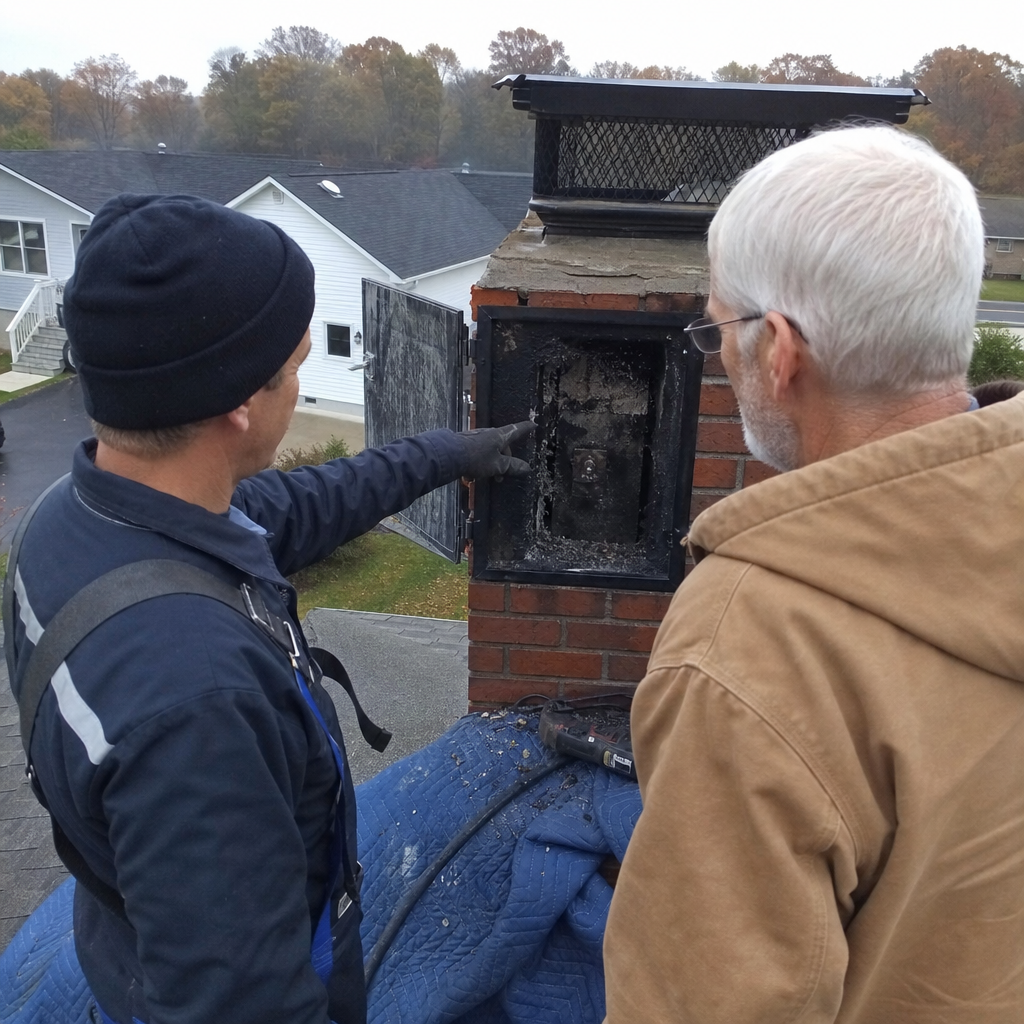
Signs Your Chimney Needs Cleaning in Greeneville, TN — What to Check Before You Light the First Fire
The most reliable signs your chimney needs cleaning appear weeks before smoke backs up into your room: an oily, tar-like smell on humid days, reduced draft on startup compared to last season, and a thin, glassy black film inside the firebox opening. If you’re noticing any of these in your Greeneville home between August and September, your flue likely has Stage 2 creosote buildup that needs professional removal before the heating season begins. Call (888) 799-1933 for a free assessment — Matthew Gonzalez, our Owner & Lead Technician, handles every inspection personally.

Why Greeneville’s Climate and Housing Create Unique Chimney Risks
Greeneville sits in the Nolichucky River valley with the Unaka Mountain ridgelines rising to over 4,000 feet just to our east. That geography pushes our winters measurably colder and wetter than Knoxville’s, which means more annual freeze-thaw cycles attacking exterior masonry and a heating season that typically runs October through April. The result? Heavier creosote loads than flatter, newer-stock Tennessee cities, and more opportunities for moisture-driven damage to go unnoticed inside the flue.
The local housing stock compounds this. Rural Greene County is dotted with tobacco-era farmhouses from the 1920s through the 1960s, most featuring original brick chimneys built without clay tile liners. When wood stoves or inserts were retrofitted decades later — often by owners, not specialists — these unlined single-flue masonry chimneys got pressed into service they were never designed for. Heavy Appalachian hardwood burning, oak and hickory being locally abundant and culturally ingrained, feeds severe creosote accumulation in these aging, linerless flues. That’s the dominant service reality we encounter, and it’s why the early warning signs here differ from what you’d watch for in a newer, lined system in Knoxville or Nashville.
On rural Greene County calls, we routinely find original 1930s–1950s single-flue chimneys silently serving double or triple duty — fireplace, wood-stove insert, and sometimes a furnace exhaust vent — a shared-flue code violation that’s extremely common in these unmodified farmhouses and almost always a discovery finding, not something the homeowner reported. Matthew catches these because he’s looking for distribution patterns of creosote and debris, not just surface soot.
The Pre-Symptom Signs Most Lists Miss
Most articles about chimney cleaning signs describe obvious end-stage problems: visible soot, smoke pouring into the living room, or the smell of dead animals. By then, you’re past the point where a simple sweep prevents damage. The useful signs are the ones you can spot in September, before the first cold snap triggers the impulse to light a fire in a flue that hasn’t been assessed since last spring.
The Oily Smell on Humid Days — Stage 2 Creosote Off-Gassing
In Greeneville’s summer humidity, creosote oils volatilize and migrate through masonry. The Nolichucky valley’s moisture causes these oils to off-gas through brick, producing a distinctive asphalt-like or tar smell in the room even when the fireplace hasn’t been used in months. This isn’t “old fireplace” smell. It’s Stage 2 creosote — the glazed, hardened form that standard brushes won’t remove — actively releasing hydrocarbons through porous masonry. If you notice this smell on humid August or September afternoons, your flue needs more than a basic sweep; it needs mechanical de-glazing or chemical treatment before the heating season concentrates those fumes indoors.
Matthew describes this as one of the most underreported early warnings he finds. “I’d rather tell you something you don’t want to hear now than have you call me after a chimney fire.” That smell means creosote has reached a stage where it’s actively deteriorating the flue environment, not just coating it.
Reduced Draft on Cold Startup
If your fire is harder to get going this year than last — more smoke in the firebox on startup, needing the door cracked longer to establish draw, or the flame leaning toward the room instead of the flue — the cause is often partial blockage from creosote narrowing the flue diameter. A 1/4-inch buildup on a standard 8×12 flue reduces cross-sectional area by roughly 15%, enough to measurably weaken draft, especially on marginal-temperature days when chimney buoyancy is already low. Track this from season to season; draft degradation is gradual enough that homeowners normalize it until it’s severe.
Glaze Inside the Firebox Opening
Run your finger along the inner walls of the firebox, above the lintel and toward the throat. A thin, glassy black film — not fluffy soot, but something that feels like hardened varnish — indicates glazed creosote has already formed at the hottest interface point. This material ignites at approximately 451°F, roughly the temperature of a well-established wood fire, and burns at over 2,000°F once lit. Its presence means the flue above it is almost certainly worse, since creosote stages progressively from throat to smoke chamber to mid-flue.
Fine Black Dust at the Throat or Stove Collar
On tobacco-era farmhouse chimneys with unlined flues, fine black dust or debris appearing around a wood stove insert collar or at the fireplace throat isn’t surface soot — it’s spalled masonry and deteriorated mortar from the interior flue wall, carried down by condensation and draft reversal. A generalist sweep might wipe it away and call the job done. Matthew recognizes this as early-stage structural deterioration that indicates the flue liner (or lack thereof) needs assessment, not just cleaning. This distinction — debris source vs. debris symptom — is what eleven years of chimney-only focus teaches you.
What Matthew Looks For: Creosote Distribution Patterns
During a Chimney Cleaning & Sweep, Matthew maps creosote staging across three zones: the throat (directly above the firebox), the smoke chamber (the angled transition to the flue), and mid-flue. The distribution pattern tells a story that no generic checklist captures.
- Throat-heavy buildup: Suggests incomplete combustion — wood too wet, air supply restricted, or the appliance being run choked down overnight. Often correctable with behavioral changes.
- Smoke chamber concentration: Indicates turbulent flow at the transition; may signal a poorly designed throat or a partial blockage above. Common in retrofitted inserts with improper connector sizing.
- Mid-flue glazing: The most dangerous pattern — creosote has condensed and hardened where flue temperatures drop below the vaporization point, typically due to exterior exposure or an oversized flue for the appliance. Requires mechanical removal; brushes alone won’t touch it.
This three-zone assessment, performed on every job, is how we catch the shared-flue violations and unlined deterioration that define Greene County’s older housing stock. It’s also why our inspection reports tend to be blunt and detailed rather than vague — Matthew runs every job himself, no subcontractors, no apprentices working unsupervised.
When to Schedule: Greeneville’s Inspection Calendar
In Greeneville, the right time to look for these signs is August through September, before the first cold snap. Our heating season runs long enough that waiting until October puts you in the queue with everyone else who just tried to light their first fire and discovered a problem. Early scheduling also means catching creosote before the first sustained fires of the season bake it harder into the flue wall, making removal more labor-intensive and costly.
Here’s what our home service calendar typically looks like for Greeneville homeowners:
| Timing | What to Check | Typical Service | Price Range |
|---|---|---|---|
| August–September | Smell test, draft check, firebox glaze inspection | Level 1 inspection + sweep | $185–$275 |
| October (early) | Pre-season verification if signs were caught early | Standard sweep | $150–$225 |
| October (post-first-fire) | Smoke backup, odor complaints, visible soot | Inspection + mechanical de-glazing | $275–$450 |
| Mid-winter | Emergency calls for performance degradation | Inspection + sweep + possible repair referral | $225–$500+ |
These ranges reflect the actual Greeneville market for owner-operated, specialist chimney work. The low end covers straightforward sweeps on lined systems with Stage 1 creosote. The high end accounts for mechanical removal of Stage 3 glazed buildup, which requires specialized chains, whips, or chemical treatment — tools and materials that generalist handymen who sweep chimneys as a side service typically don’t carry. We stock professional-grade equipment including HeatShield refractory repair systems, Gelco chimney caps, and Olympia Chimney liner components for jobs that reveal deeper needs during inspection.
Gas Fireplaces: Different Signs, Same Need for Assessment
Gas fireplace owners often assume they don’t need chimney service. The signs differ — white or gray powdery deposits on logs, delayed ignition, or a faint sulfur smell — but the underlying issue is similar: incomplete combustion products condensing in the flue, plus potential debris from deteriorating liner mortar or animal nesting in unused venting. In Greeneville’s older homes with multi-flue masonry chimneys, gas appliance vents sometimes share flue space with abandoned fireplace flues, creating draft interference that only a camera inspection reveals. Don’t assume gas means maintenance-free; assume it means different warning signs until proven otherwise.
FAQs
A standard chimney sweep and Level 1 inspection in Greeneville typically runs $150–$275, depending on creosote stage and accessibility. Glazed creosote removal or mechanical de-glazing adds $100–$175. Call (888) 799-1933 for an exact quote — estimates are free, and Matthew performs every assessment personally.
DIY chimney cleaning with a hardware-store brush kit costs $30–$80 but risks incomplete removal, especially of Stage 2–3 glazed creosote, and provides no inspection of flue liner condition or structural deterioration. Given that chimney fires from missed glazed buildup can cause $10,000+ in damage, professional service pays for itself in risk reduction alone. Matthew’s eleven years of chimney-only work means he catches the distribution patterns and structural issues a homeowner won’t recognize.
The National Fire Protection Association recommends annual inspection; in Greeneville’s extended heating season and with heavy hardwood burning, we advise annual sweep for active wood-burning systems and biennial minimum for gas. Unlined masonry chimneys in older Greene County farmhouses often need more frequent attention due to accelerated interior deterioration from freeze-thaw cycling and higher moisture content in Appalachian combustion air.
We maintain same-day and next-day availability for active safety concerns during peak season (September–November), though scheduling two–three weeks ahead in August–September secures your preferred slot before the rush. Emergency calls for smoke backup or suspected blockage get priority. Call (888) 799-1933 — if we can’t get to you same-day, we’ll talk through immediate safety steps to keep you safe until arrival.
What Happens If You Ignore the Early Signs
Stage 2 creosote doesn’t remain Stage 2. Every fire season bakes it harder, moving it toward Stage 3 — the dense, tar-like layer that requires aggressive mechanical removal and can only be partially addressed in a single visit. Meanwhile, the underlying flue deterioration in unlined masonry continues, spalling more material, widening mortar gaps, and eventually creating pathways for combustion gases into wall cavities. In Greeneville’s older housing stock, we’ve removed chimney caps to find flue walls eroded to half their original thickness, with homeowners unaware because the damage was above the smoke chamber and invisible from below.
The shared-flue violations we discover in rural farmhouses — fireplace, wood stove, and furnace venting through a single unlined flue — create compounded risks: backdrafting of furnace exhaust into living space, oxygen starvation for combustion appliances, and accelerated deterioration from multiple temperature cycles. These aren’t hypotheticals; they’re routine findings on calls where the homeowner originally just wanted “a cleaning.”
Key Takeaways: What to Watch For This Season
- August–September smell test: Oily, tar-like odor on humid days means Stage 2 creosote is active — schedule before first fire.
- Draft comparison: Harder startup than last year suggests flue narrowing; don’t normalize gradual degradation.
- Firebox inspection: Glassy black film above the lintel indicates glazed creosote requiring professional removal.
- Dust at stove collar: Fine black debris may signal masonry deterioration, not just surface soot — needs specialist assessment.
- Schedule early: Greeneville’s heating season runs long; October booking means longer waits and baked-in creosote.
If you’d rather have it looked at, Premier Chimney Cleaning Service Greeneville offers a no-pressure assessment — Matthew Gonzalez, Owner & Lead Technician, handles every inspection personally, with 387 customers rating our work 4.9 stars across eleven years of chimney-only service. Call (888) 799-1933 for a free estimate.
Written by Matthew Gonzalez, Owner & Lead Technician at Premier Chimney Cleaning Service Greeneville, serving Greeneville, TN.